Riad Ibadulla, Thomas M. Chen, Constantino Carlos Reyes-Aldasoro
IEEE Transactions on Neural Networks and Learning Systems, 2026
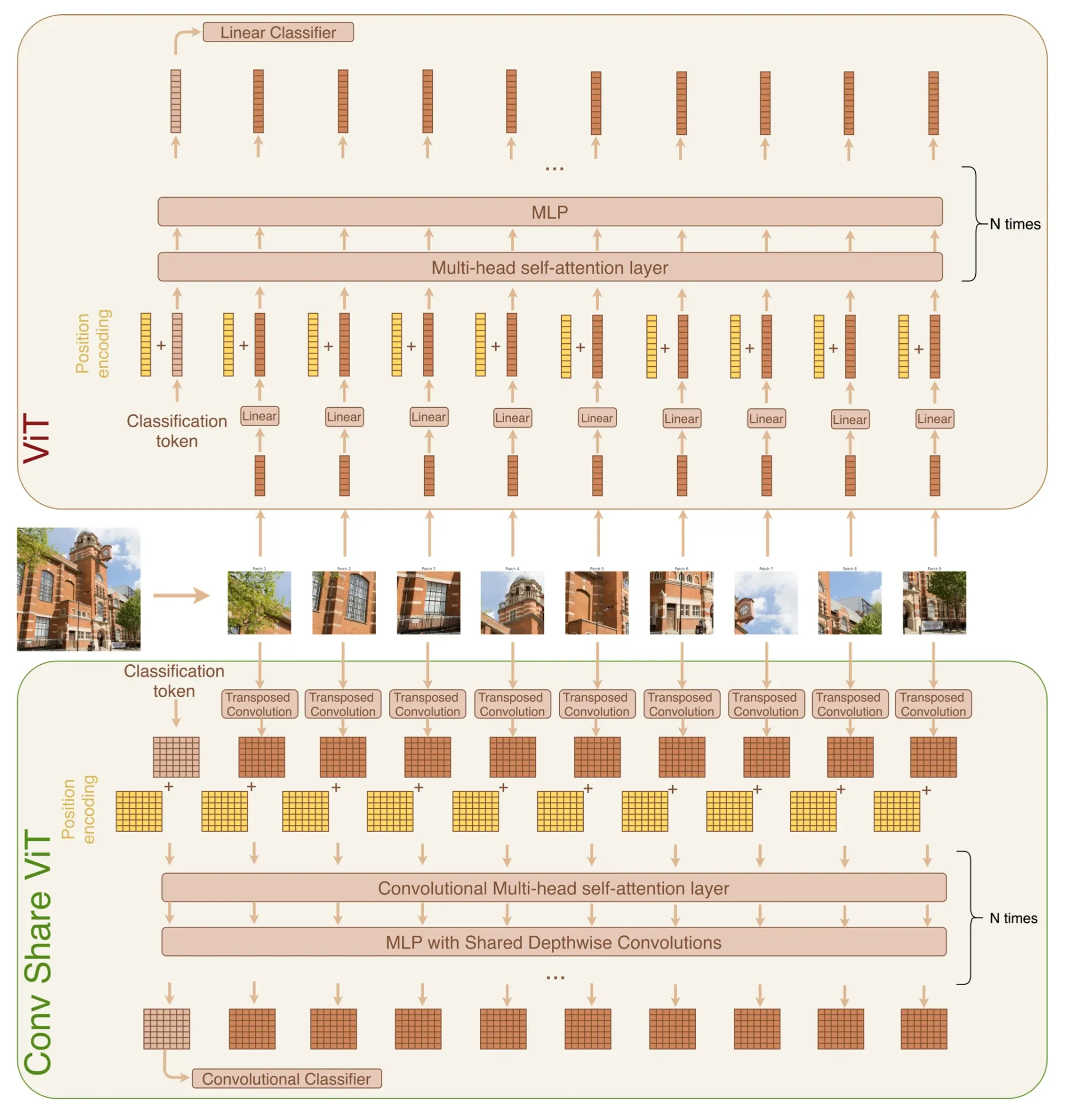
Adapts the Vision Transformer so that it can run on a 4f optical system using only convolutions: the linear layers in attention and MLP blocks are replaced by depthwise convolutions with weights shared across channels. Some configurations learn attention comparable to a standard ViT, and the design could in theory run up to 3.04 times faster than GPU inference.
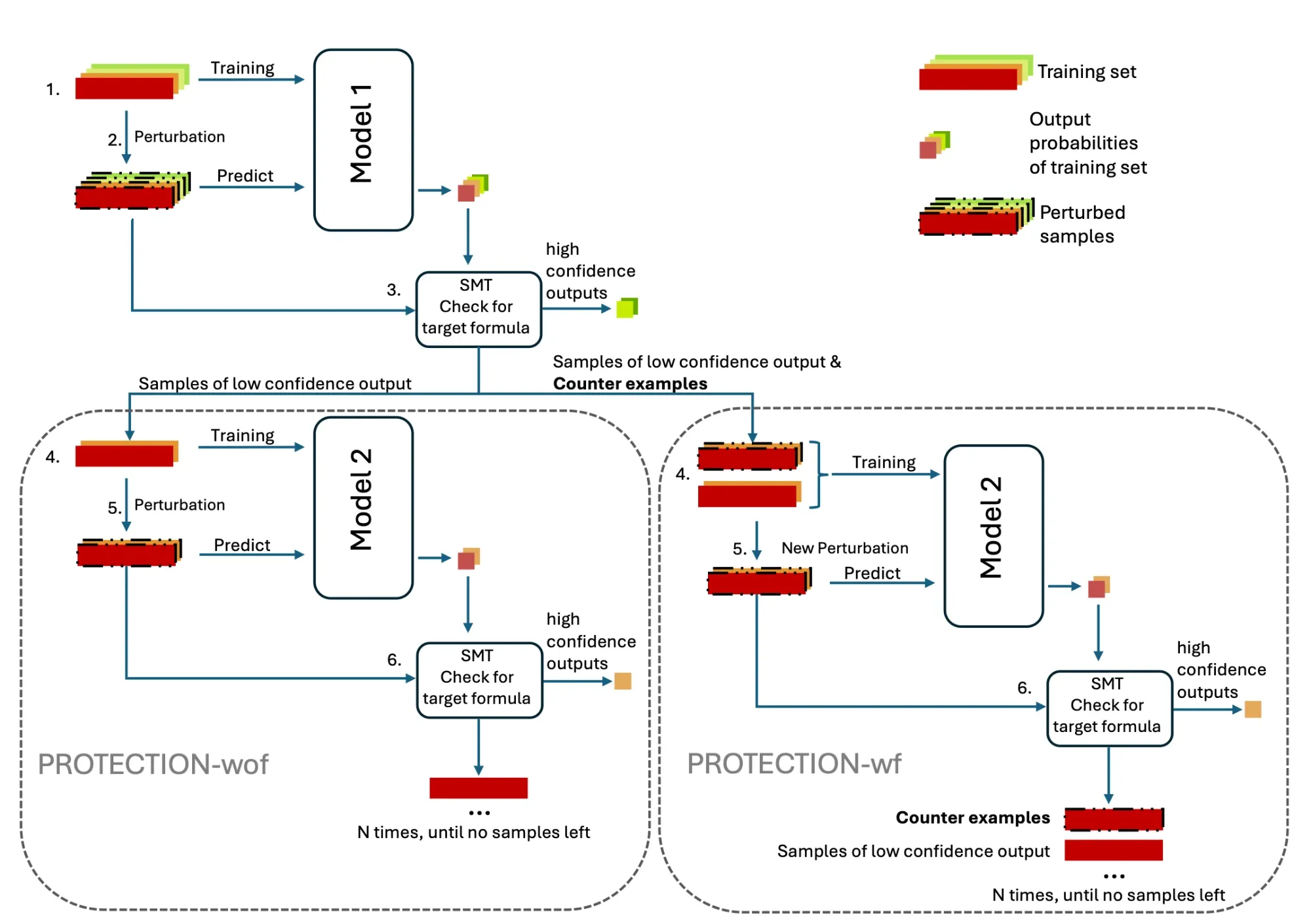
Machine-learning intrusion detection systems protect IoT networks, but they can be fooled by adversarial inputs and give no formal guarantee of robustness. PROTECTION combines ensemble machine learning with formal verification using Satisfiability Modulo Theories (SMT), checking that the classifier’s output probabilities stay stable when its inputs are slightly altered.
D. Brito-Pacheco, Riad Ibadulla, X. Fernández, P. Giannopoulos, Constantino Carlos Reyes-Aldasoro
Medical Image Understanding and Analysis (MIUA 2025), Springer, 2025
Two colorectal cancer histology datasets, NCT-CRC-HE-100K and CRC-VAL-HE-7K, are widely used together as training and testing sets. Features extracted with persistent homology and Gabor filters show that the two sets have noticeably different distributions, which matters for anyone benchmarking models on them.
Riad Ibadulla, Constantino C. Reyes-Aldasoro, Thomas M. Chen
Proc. SPIE 12903, AI and Optical Data Sciences V (SPIE Photonics West), 2024
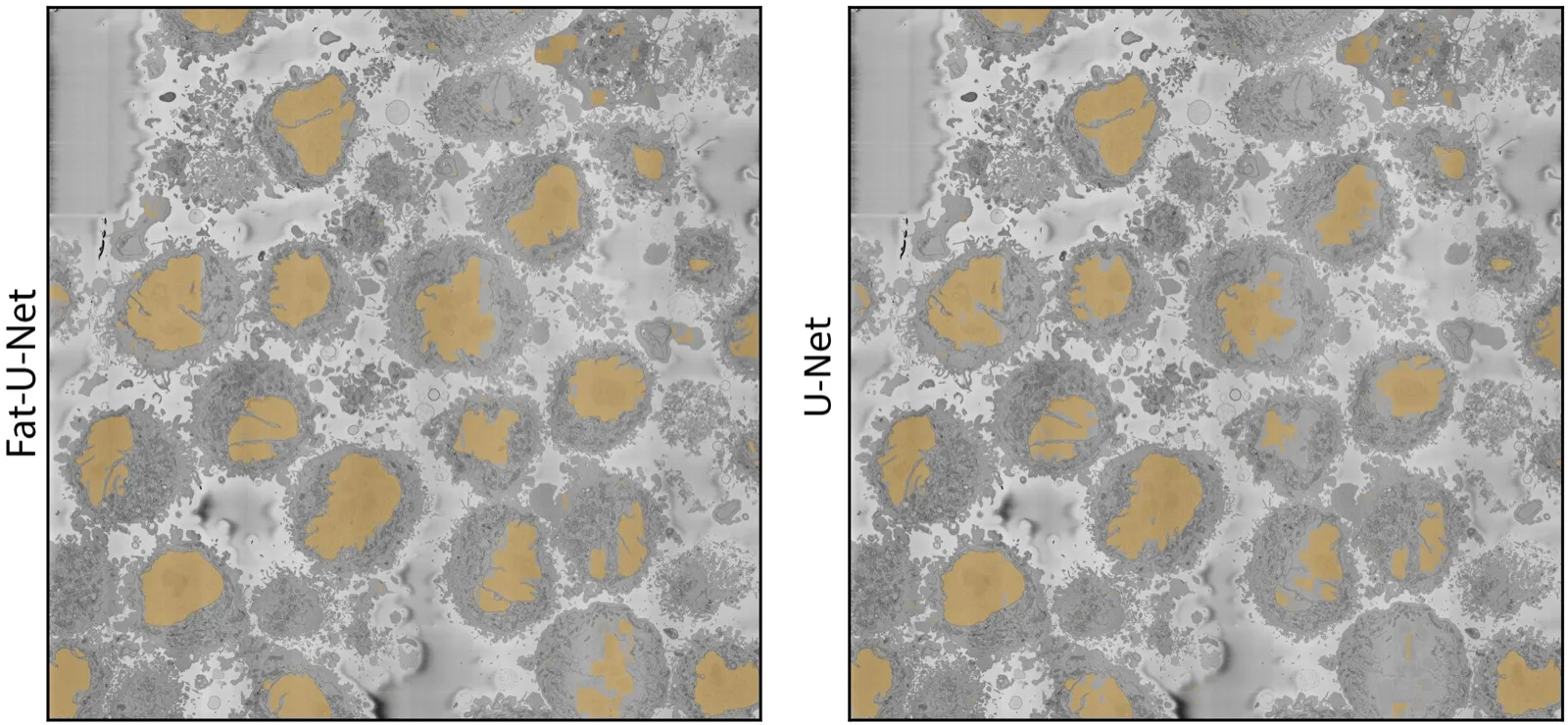
Applies the FatNet approach to U-Net for image segmentation, removing the pooling steps so that resolution stays high throughout. On a 4f optical system, Fat-U-Net is estimated to run 538 times faster than U-Net on the same optical hardware and 37 times faster than U-Net on a GPU, with IoU reductions of 4.24% on Oxford-IIIT Pet and 1.76% on HeLa cell nuclei.
Riad Ibadulla, Thomas M. Chen, Constantino Carlos Reyes-Aldasoro
AI (MDPI), vol. 4, no. 2, pp. 361–374, 2023
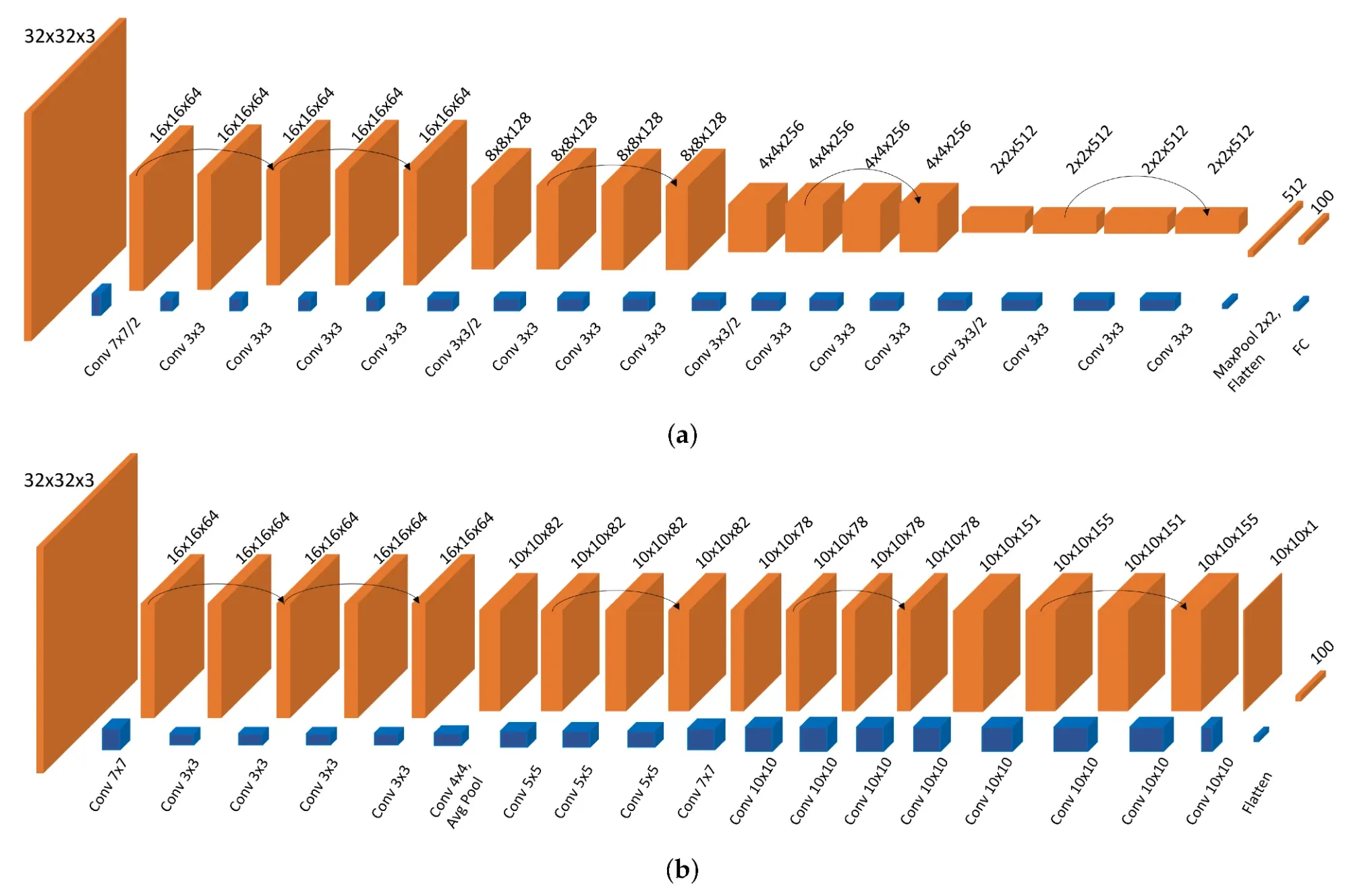
Optical accelerators can process high-resolution images at no extra cost, but standard CNNs rely on many low-resolution channels. FatNet converts a classification network into a fully convolutional one with fewer channels and larger, high-resolution kernels. Compared with ResNet-18 on CIFAR-100, it needs 8.2 times fewer convolution operations for a 6% drop in accuracy.
High Resolution Capabilities of Free-space Optical Neural Networks. PhD thesis, City,
University of London, 2024. Introduces FatNet, a method for converting conventional neural networks into a form
suited to the 4f optical system by trading channels for feature-map resolution, and extends it to segmentation
and Vision Transformers.